.: September 9, 1996.: November 8, 1996Mode(s)Crash Bandicoot is a developed by and published by for the. The game was released in North America in September 1996, and in Europe in November 1996.Crash Bandicoot is the first installment in the series, chronicling the creation of the at the hands of series antagonist and henchman. The story follows Crash as he aims to prevent Brio and Cortex's plans for world domination, and rescue his girlfriend, a female bandicoot also evolved by Brio and Cortex.Crash Bandicoot received generally positive reviews from critics, who praised the game's graphics and unique visual style, but criticized its controls and lack of innovation as a platform game.
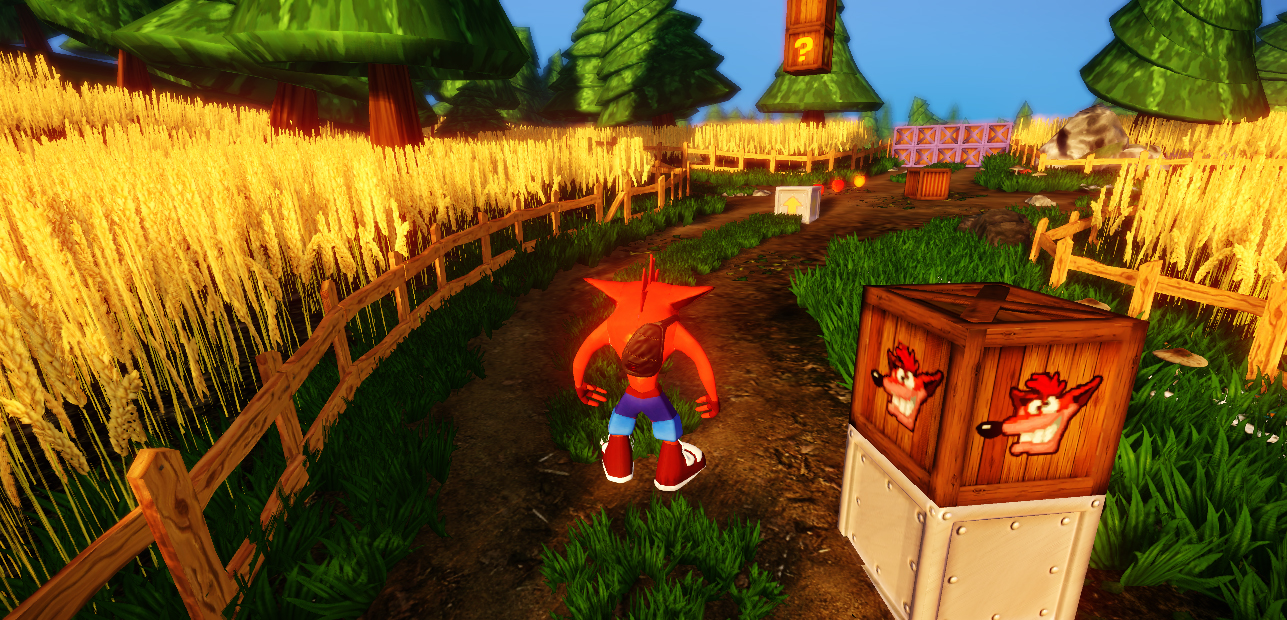
The game went on to sell over 6 million units, making it the eighth, and the highest selling ranked on sales in the United States. A remastered version, included in the collection, was released for the in June 2017, and ported to other platforms in June 2018. Crash comes across various crates throughout the game (pictured), many of which contain Wumpa Fruit. When 100 Wumpa Fruits are collected, the player earns an extra life.Crash Bandicoot is a platform game in which players control the titular protagonist, as he traverses several in sequence in order to progress.
Crash is able to defeat enemies by either jumping on them or using a spinning attack that launches them. Crash will lose a life if he is hit by an enemy or obstacle, or falls into a bottomless pit. Crash can protect himself by collecting masks, which protect Crash from a single hit from an enemy or obstacle (but not pits or other instant-death obstacles). Crash can hold onto two masks at a time and, upon collecting a third mask, will gain temporary invincibility. The game ends when the player runs out of lives, with more lives earned by finding extra life items or by collecting 100 Wumpa Fruits.Scattered throughout each level are various types of crates, most of which contain items such as Wumpa Fruit and Aku Aku masks, which can be broken by jumping on or spinning into them. Other types of crate include checkpoint crates, which lets players resume their progress after losing a life, arrow crates which Crash can bounce on, and explosive crates that explode upon being broken, or following a timer that activates by jumping on them.
Certain crates, including steel platform crates, are invisible, requiring the player to hit an exclamation box to make them tangible. If the player clears a level with all crates broken without dying, they will earn a gem. Additional gems can be obtained through hidden levels or alternative routes, and some gems are required to access new areas. Collecting all gems in the game allows the player to reach its true ending. If the player manages to collect enough bonus icons, they will be warped to a Bonus Stage which, upon completion, will allow the player to save their progress, either via memory card or password. Plot In a southeast Australian archipelago, Doctor Neo Cortex and his assistant Doctor Nitrus Brio use a device called the Evolvo-Ray to mutate the various animals living on the islands into beasts with superhuman strength.
They experiment on Crash, a peaceful who Cortex intends to be the leader of his growing military of animal soldiers. Despite Brio's warnings, Cortex subjects Crash to the untested Cortex Vortex in an attempt to control him. The Vortex rejects Crash, allowing him to escape. After Crash leaps out a window and falls to the ocean below, Cortex prepares a female bandicoot named Tawna for experimentation. Having grown attached to Tawna during their time in captivity, Crash resolves to rescue her and defeat Cortex. From the beach of N.
Sanity Island, Crash traverses through the islands and faces off against such adversaries as the local tribe leader Papu Papu, the deranged kangaroo Ripper Roo, the muscular Koala Kong, and the gangster Pinstripe Potoroo. Within Cortex's castle, Crash is confronted by Brio inside his laboratory. Brio uses chemicals to mutate himself into a. While Crash successfully defeats Brio, the castle laboratory catches on fire during the struggle.
Crash escapes to Cortex's, where he confronts Cortex himself as the castle burns. Cortex attacks him with a, but Crash deflects his own projectiles against him and sends Cortex falling out of the sky. Tawna embraces Crash as the two escape the burning castle on Cortex's airship. Development.
Gavin and Rubin co-created the concept for Crash Bandicoot during a cross-country trip from Boston to Los Angeles. Conception Before presenting to of, Naughty Dog was signed on to the company for three additional games. In August 1994, Jason Rubin and Andy Gavin began their move from, to,. Before leaving, Gavin and Rubin hired Dave Baggett, their first employee and a friend of Gavin's from the; Baggett would not start working full-time until January 1995. During the trip, Gavin and Rubin studied arcade games intensely and noticed that racing, fighting and shooting games had begun making a transition into full 3D rendering. Sensing opportunity, they turned to their favorite video game genre, the character-based action-platform game, and asked themselves what a three-dimensional version of such a game would be like. Because the player would be forced to constantly look at the character's rear, the hypothetical game was jokingly called 's Ass Game'.
The basic technology for the game and the Crash Bandicoot series as a whole was created somewhere near. The rough game theory was designed near. Soon afterward, Gavin and Rubin threw out their previous game design for Al O.
Saurus and Dinestein, a based on and scientists genetically merged with.In August 1994, Naughty Dog moved into their new offices and met with Mark Cerny. The group unanimously liked the 'Sonic's Ass Game' idea and debated on what video game system the game would be for. Deciding that the, and were unsatisfactory options due to poor sales and 'clunky' development units, the team chose to develop the game for Sony's PlayStation due to the console's 'sexy' nature and the company's lack of an existing competing mascot character. After signing a developer agreement with Sony, Naughty Dog paid $35,000 for a PlayStation development unit and received the unit in September 1994. A development budget of $1.7 million was set for the game, and former director David Siller was hired to be the producer.Character and art design Before the development of Crash Bandicoot, Naughty Dog wanted to do what and did while designing their respective characters, and the, and incorporate an animal that was 'cute, real, and no one really knew about'. The team purchased a field guide on Tasmanian mammals and selected the, and as options. Gavin and Rubin went with 'Willie the Wombat' as a temporary name for the starring character of the game.
The name was never meant to be final due both to the name sounding 'too dorky' and to the existence of a non-video game property of the same name. The character was effectively a bandicoot by October 1994, but was still referred to as 'Willie the Wombat' as a final name had not been formulated yet. It was decided that the main character would be mute because past voices for video game characters were considered to be 'lame, negative, and distracted from identification with them.' The villain of the game was created while Gavin, Rubin, Baggett, and Cerny were eating 'mediocre ' near the Universal Interactive Studios lot. Gavin idealized an 'evil genius villain with a big head' who was 'all about his attitude and his minions'. Rubin, having become fond of the animated television series, imagined a 'more malevolent Brain' with minions resembling the weasel characters in.
After Gavin performed a 'silly villain voice' depicting the attitude in mind for the character, the villain's name, Doctor Neo Cortex, was instantly formulated.To aid in the visual aspect of production, David Siller recruited Joe Pearson of Epoch Ink, who in turn recommended that of American Exitus be brought on board as well. Pearson and Zembillas would meet with Naughty Dog weekly to create the characters and environments of the game. Because the main character was Tasmanian, it was decided that the game would take place on a mysterious island where every possible type of environment could be found, with the added reasoning that an evil genius like Doctor Neo Cortex would require an island stronghold. On creating the levels for the game, Pearson first sketched each environment, designing and creating additional individual elements later. Pearson aimed for an organic, overgrown look to the game and worked to completely avoid straight lines and 90-degree corners.
In January 1995, Rubin became concerned about the programmer-to-artist ratio and hired Bob Rafei and Taylor Kurosaki as additional artists. A Naughty Dog artist sketched every single background object in the game before it was modeled. Naughty Dog's artists were tasked with making the best use of textures and reducing the amount of geometry.
Dark and light elements were juxtaposed to create visual interest and separate geometry. The artists would squint when sketching, texturing, and playing the levels to make sure they could be played by light value alone. They ensured to use color correctly by choosing mutually accentuating colors as the theme for the 'Lost City' and 'Sunset Vista' levels. The interior of Cortex's castle was designed to reflect the inside of his mind. According to Rubin, the artists worked on the visuals for eight months before any game code was written.
Graphics The PlayStation had a 512 × 240 video mode which used up that would normally be used for textures, but was effective in rendering shaded but untextured polygons at a sharper detail. Rubin pointed out that since the polygons on the characters were just a few pixels in size, shaded characters would look better than textured ones. Thus, polygons were emphasized over textures; this was advantageous in that it allowed the programmers more polygons to work with and allowed them to work around the PlayStation's lack of texture correction or polygon clipping. To give the game more of a resemblance to an animated cartoon, was implemented rather than the standard with 'one-joint' weighting; this allowed the programmers to use the more sophisticated three-to-four-joint weighting available in. Because the PlayStation was unable to match this at runtime, the location of every vertex was stored in every frame at 30 frames a second. Gavin, Baggett, and Cerny attempted to invent assembly language vertex compressors for this manner of animation; Cerny's version was the most successful and the most complicated.To obtain the graphic details seen in the game, Rubin, Gavin, and Baggett researched visibility calculation in video games that followed and concluded that extensive pre-calculation of visibility would allow the game to render a larger number of polygons.
Following experimentation in free-roaming camera control, the team settled with a branching rail camera that would follow along next to, behind, or in front of the character, generally looking at him, moving on a 'track' through the world. Because only 800 polygons could be visible on the screen at a time, parts of the game's landscape would be hidden from view using trees, cliffs, walls, and twists and turns in the environment. Because the production used an entirely and -based tool, the programmers used $100,000 Silicon Graphics workstations instead of the $3,000 that were the standard at the time.
Gavin created an algorithmic texture packer that would deal with the fact that the 512 × 240 video mode left too little texture memory. Meanwhile, Baggett created bidirectional 10x compressors that would reduce the 128-megabyte levels down to 12 megabytes and allow them to be compatible with the PlayStation's 2-megabyte random access memory.
The levels proved to be so large that the first test level created could not be loaded into Alias PowerAnimator and had to be cut up into 16 chunks. Each chunk took about 10 minutes to load even on a 256-megabyte machine. To remedy the situation, Baggett created the DLE, a level design tool where component parts of a level were entered into a text file, with a series of layers indicating how the parts were combined. To code the characters and gameplay of the game, Andy Gavin and Dave Baggett created the programming language 'Game-Oriented Object ' (GOOL) using LISP syntax. Level design The first 2 test levels created for the game did not ship in the final version for being too open and featuring too many polygons.
During the summer of 1995, the team focused on creating levels that were functional as well as fun and used the Cortex factory levels to experiment on this goal; the mechanical setting allowed the team to forego the complex and organic forest designs and distill the two-axis gameplay in an attempt to make it fun. Their first two successful levels ('Heavy Machinery' and 'Generator Room') utilized 2.5D gameplay and featured basic techniques previously used in, such as steam vents, drop platforms, bouncy pads, heated pipes and enemy characters that would move back and forth, all of which would be arranged in progressively more difficult combinations as the level went on. 'Willie's jumping, spinning and bonking mechanisms were refined in these two levels.
Crash 1996 Uncut Download Games Pc
The level 'Cortex Power' incorporates the original 'Sonic's ass' point of view (behind the character and over his shoulder) featured in the two test levels. After working on those three levels, the first successful jungle-themed level (later titled 'Jungle Rollers') was created from pieces of the failed first test level arranged into a corridor between trees. From that point forward, two to three levels would be created for each level theme featured, with the first level featuring an introductory set of challenges and later levels adding new obstacles (such as dropping and moving platforms in the second jungle-themed level) to increase the difficulty.While playing the game during development, Rubin realized that there were many empty areas in the game due to the PlayStation's inability to process numerous on-screen enemy characters at the same time. Additionally, test players were solving the game's puzzles too fast. In an attempt to remedy this, the 'Wumpa Fruit' pickup was created (the fruits themselves were rendered in 3D into a series of textures), but was not exciting enough on its own.
On a Saturday in January 1996, Gavin coded the 'crates' while Rubin modeled a few basic crates and an exploding TNT crate and drew quick textures. The first few crates were placed in the game 6 hours later, and many more would be placed during the following days.
Post-production In September 1995, Andy Gavin and Taylor Kurosaki took footage from the game and spent two days editing it into a two-minute 'preview tape', which would be deliberately leaked to a friend at Sony Computer Entertainment so that the company may view it. Due to management issues at Sony, it would not be until March 1996 that Sony would agree to publish the game, which went into the alpha stage in April 1996. While preparing for the game's demonstration at the, the team decided to finally rename the title character 'Crash Bandicoot' (the particular name being credited to Dave Baggett and Taylor Kurosaki ), with his surname being based on his canonical species and his first name stemming from the visceral reaction to the character's destruction of boxes ('Dash', 'Smash', and 'Bash' were other potential names). The name change was contested between Naughty Dog and marketing director Kelly Flaherty, who was discredited in postmortems by Gavin and Rubin.The music of Crash Bandicoot was a last-minute aspect added to the game before its showing at the Electronic Entertainment Expo.
The producer of Universal Interactive proposed that rather than conventional music, an 'urban chaotic symphony' would be created by Andy Gavin causing random sound effects (such as, grunts, and ) to be randomly selected and combined. When this proposal was rejected, David Siller introduced the team to the music production company and its founder. Following this introduction, Mothersbaugh selected to compose the music for the game based on his previous work on. Mothersbaugh advised Mancell throughout the soundtrack's stages, after which all composition duties of Crash Bandicoot and Naughty Dog's subsequent six titles were delegated to Mancell., and served as influences on Mancell's 'simple but kind of off-kilter' melodies. Dave Baggett served as the soundtrack's producer.
The sound effects were created by Mike Gollom, Ron Horwitz and Kevin Spears of Universal Sound Studios. The voices in the game were provided by actor and the game's producer David Siller.In a continuing attempt by Universal Interactive to take credit for Crash Bandicoot, Naughty Dog was told that it was not 'allowed' to go to the first Electronic Entertainment Expo. In addition, there were leaked copies of the temporary box cover and press materials for the Electronic Entertainment Expo, upon which the Naughty Dog logo was not found on the box art, in violation of the contract between Naughty Dog and Universal Interactive, was omitted. In response, Jason Rubin drafted and printed 1,000 copies of a document entitled 'Naughty Dog, creator and developer of Crash Bandicoot' to hand out in front of the Crash Bandicoot display at the Electronic Entertainment Expo. Beforehand, Rubin passed out the flyers 'for review' to Universal Interactive, angering its president. Crash Bandicoot was first shown at the Electronic Entertainment Expo on May 1996 and was met with enthusiastic reactions. The game was released on September 9, 1996.
This was followed by its European release on November 8, 1996. Japanese distribution In preparation for presenting Crash Bandicoot to Sony's Japanese division, Gavin spent a month studying anime and manga, reading English-language books on the subject, watching Japanese films and observing competitive characters in video games. Upon Naughty Dog's first meeting with the executives of Sony Computer Entertainment Japan, the executives handed Naughty Dog a document that compared Crash with Mario. Although Crash was rated favorably in the graphics department, the main character and the game's non-Japanese 'heritage' were seen as weak points.
The renderings of the character made specifically for the meeting also proved unimpressive. During a break following the initial meeting, Gavin approached Charlotte Francis, the artist responsible for the renderings, and gave her fifteen minutes to adjust Crash's facial structures. Sony Japan bought Crash for Japanese distribution after being shown the modified printout. Pop-up text instructions given by Aku Aku were added for the Japanese version of the game. The localization hid the game's American origins as much as possible, featuring no for instance. The Japanese version was released on December 9, 1996. It was later rereleased as part of range on May 28, 1998, with the release followed on October 12, 2001.
Reception ReceptionAggregate scoreAggregatorScore80%Review scoresPublicationScore8.4/109/103.5/57.5/10Gaming Target9.3/10AwardPublicationAwardGame of the MonthCrash Bandicoot received generally favorable reviews from critics, with much of the positive comments going to the graphics. Of GameFan referred to the visuals as 'the best graphics that exist in a game' and the design and animations of the title character as '100% perfection'. Crispin Boyer of said it had the best graphics of any PlayStation game to date. A critic summarized that 'it's bright and colorful, includes a lot of impressive graphic flourishes, controls well, and, in the strictest sense, uses a 3D environment to good effect without a hint of '.
John Scalzo of Gaming Target described the environments as 'colorful and detailed' and mentioned the snowy bridge and temple levels as his favorites. However, he noted that the boss characters appeared to be noticeably polygonal compared to the other characters due to their large size. He added that this flaw was excusable because of the game's age and that the game's graphics were near perfect otherwise. A reviewer for Game Revolution singled out the scaling technology for praise and declared it to be 'the new standard for Playstation action games the same way SGI did for 16-bitters after Donkey Kong Country'. Additionally, he described the texture-mapping precision as 'awesome', the shading as 'almost too well done' (the reviewer claimed it made the game more difficult by making the pits appear to be shadows and vice versa), the polygon movements as 'very smooth and fluid', the 'quirky mannerisms' of the title character as 'always refreshing' and the backgrounds as 'breathtakingly beautiful (especially the waterfall stages)'. However, the reviewer said that the ability to adjust the camera angle even slightly 'would have been a definite plus (at times the ground itself is at 75 degree angle while Crash constantly moves at 90 degrees, putting a slight strain on the eyes).' This echoed Tommy Glide of, who said 'Trying to judge distances from the mostly static view behind Crash is the game's main flaw', while highly praising the scenery and effects.
A reviewer for IGN noted that 'gorgeous backgrounds and silky smooth animation make this one of the best-looking titles available for the PlayStation.' The gameplay received mixed responses. Both John Scalzo and the Game Revolution reviewer compared the gameplay to Donkey Kong Country, with Scalzo describing the game as having a 'familiar, yet unique' quality that he attributed to Naughty Dog's design, while the Game Revolution reviewer concluded that the game 'fails to achieve anything really new or revolutionary' as a platform game, and the Next Generation reviewer went so far as to call it 'the single most derivative game to ever hit a console', adding that 'anyone who's played even one side-scrolling action game could have come up with every single game element found in Crash.'
Electronic Gaming Monthly 's four reviewers, while having a more positive overall impression of the game, admitted that the gameplay is short on originality, with Shawn Smith summarizing, 'It's like the original Mario with some 3-D effects thrown in.' They also noted that the gameplay is not genuinely 3-D, though they praised the mixture of side scrolling, front scrolling, and back scrolling sections.
Tommy Glide remarked that the gameplay 'lacks some of the diversity and innovative next-gen qualities found in 's and 's.' The IGN reviewer said that the game 'isn't a revolution in platform game design.
It's pretty much your standard platform game'. However, he noted the game's 'surprisingly deep' depth of field and use of different perspectives as exceptions to the platforming formula.
Jim Sterling of Destructoid.com stated that the game has aged poorly since its initial release and cited the lack of support for thumbsticks, a poor camera as well as substandard jumping and spinning controls.Crash Bandicoot was a commercial hit. By late February 1998, its sales in Japan and Europe had reached 610,000 and 725,000 units, respectively. The United States accounted for 1.5 million units by that time. Sales continued through 1998: tracked 771,809 domestic sales of Crash Bandicoot for the year, which drew $16 million in revenue and made it the United States' 10th-best-selling PlayStation release of the year.
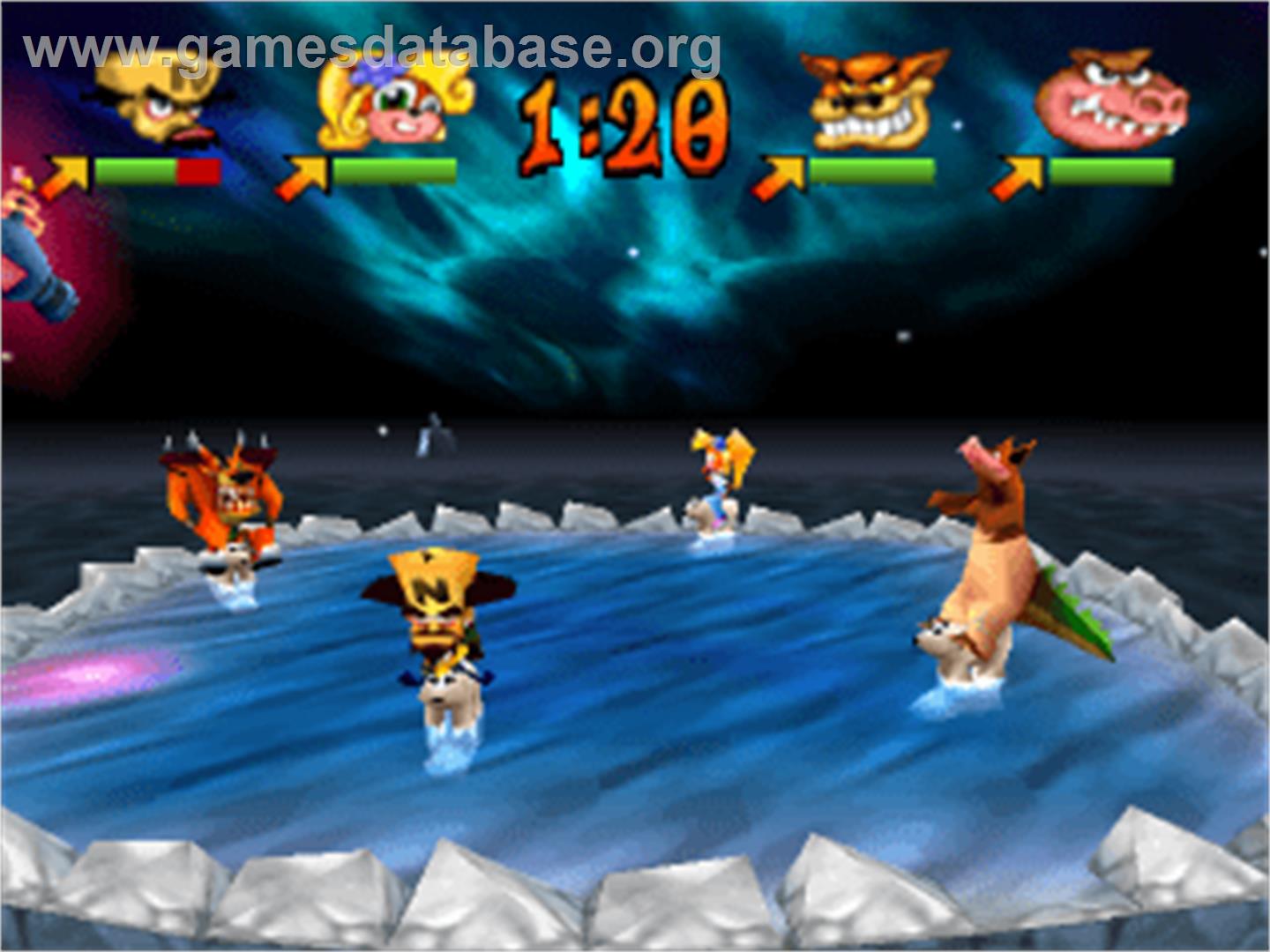
At the 1999 Milia festival in, Crash Bandicoot took home a 'Gold' prize for revenues above €17 million in the during 1998. By February 1999, 4.49 million copies of Crash Bandicoot had been shipped to retailers worldwide. As of November 2003, Crash Bandicoot has sold over 6.8 million units worldwide, making it one of the. The game's success lead to its inclusion for the. Crash Bandicoot was the first non-Japanese game to receive a 'Gold Prize' in Japan for sales of over 500,000 units. The game spent nearly two years on the TRSTS top 20 PlayStation sales charts before finally dropping off on September 1998. Guinness World Records Gamer's Edition 2015 Ebook.
November 6, 2014. The NPD Group. November 6, 2018., p. 9-10. 'Gamer's Edge'.
3. Naughty Dog (September 9, 1996). Crash Bandicoot. Sony Computer Entertainment. Level/area: Opening sequence.
Doctor Nitrus Brio: But Doctor Cortex, we have not determined the cause of past failures! / Doctor Neo Cortex: Moron! This bandicoot will be my general, and he will lead my Cortex Commandos to world domination! This time I shall reign triumphant!. Naughty Dog (September 9, 1996). Crash Bandicoot. Sony Computer Entertainment.
Level/area: Opening sequence. Doctor Neo Cortex: We are closer than ever before. Into the Vortex! / Doctor Nitrus Brio: But Doctor Cortex, the Vortex is not ready. We have no idea what it could do!.
Naughty Dog (September 9, 1996). Crash Bandicoot. Sony Computer Entertainment. Level/area: Opening sequence.
Doctor Neo Cortex: Failure again! Capture him!. ^, p. 4. Naughty Dog (September 9, 1996). Crash Bandicoot. Sony Computer Entertainment.
Level/area: Opening sequence. Doctor Neo Cortex: Prepare the female bandicoot.
Naughty Dog (September 9, 1996). Crash Bandicoot. Sony Computer Entertainment. Level/area: N.
Sanity Beach. Naughty Dog (September 9, 1996). Crash Bandicoot. Sony Computer Entertainment. Level/area: Papu Papu. Naughty Dog (September 9, 1996).
Crash Bandicoot. Sony Computer Entertainment. Level/area: Ripper Roo. Naughty Dog (September 9, 1996). Crash Bandicoot.
Sony Computer Entertainment. Level/area: Koala Kong. Naughty Dog (September 9, 1996). Crash Bandicoot. Sony Computer Entertainment. Level/area: Pinstripe.
Naughty Dog (September 9, 1996). Crash Bandicoot. Sony Computer Entertainment. Level/area: Doctor Neo Cortex. Doctor Neo Cortex: Darn you, Crash Bandicoot! ( equips plasma gun and fires projectiles) Ha ha ha!.
Naughty Dog (September 9, 1996). Crash Bandicoot.
Sony Computer Entertainment. Level/area: Doctor Neo Cortex. ^ 'From Rags to Riches: Way of the Warrior to Crash 3'. United States:. October 1998. Pp. 18–19. ^.
Archived from on July 29, 2008. Tiger woods pga tour 09 all play wii cheats free. Retrieved March 8, 2010. ^ Andy Gavin (February 2, 2011).
All Things Andy Gavin. Retrieved February 7, 2011.
^ Andy Gavin (February 3, 2011). All Things Andy Gavin. Retrieved February 7, 2011. Jason Rubin (2004). Retrieved November 23, 2015.
Superannuation (January 15, 2014). Retrieved November 23, 2015. Crash Bandicoot - $1.7 million - During a 2004 Australian Games Developer Conference presentation, Naughty Dog cofounder Jason Rubin said the development budget for their signature PlayStation platformer was $1.7 million.
Archived from on July 28, 2008. Retrieved March 8, 2010. 'The Secret Behind Crash's Flash'. P. 59. ^ Andy Gavin (February 4, 2011). All Things Andy Gavin.
Retrieved February 7, 2011. Andy Gavin (February 5, 2011). All Things Andy Gavin. Retrieved March 2, 2011.
^ Andy Gavin (February 6, 2011). All Things Andy Gavin. Retrieved March 2, 2011. ^ Andy Gavin (February 7, 2011). All Things Andy Gavin. Retrieved March 2, 2011.
Retrieved 2016-11-08. March 27, 2014. Retrieved July 19, 2014., p. 24. Naughty Dog (September 9, 1996). Crash Bandicoot.
Sony Computer Entertainment. Level/area: Credits. Voice characterization: Brendan O'Brien. Behind The Voice Actors. Retrieved 2019-05-29., retrieved 2019-05-29. Archived from on August 31, 2015.
Retrieved August 7, 2016. United Kingdom:. November 1996. P. 49. 'CTW Games Guide'. Computer Trade Weekly. United Kingdom.
November 4, 1996. P. 36. 'PlayStation Expo: Sony Shows Off in Japan'.
January 1997. (in Japanese). From the original on July 18, 2015. Retrieved July 18, 2015. ^. Retrieved March 10, 2010.
^ 'Review Crew: Crash Bandicoot'. October 1996. Sunrise Publications. September 1996. Archived from on January 17, 1997. Retrieved April 8, 2011. ^.
Game Revolution. June 4, 2004. Retrieved March 10, 2010. ^. November 21, 1996.
Retrieved March 10, 2010. ^ John Scalzo (August 16, 2002). Gaming Target. Retrieved April 3, 2011. ^ 'No New Tricks'. November 1996.
P. 267. Dave Halverson. Archived from on July 23, 1997.
Retrieved April 3, 2011. ^ 'ProReview: Crash Bandicoot'. October 1996. Pp. 78–79. Jim Sterling (November 7, 2009). Retrieved February 11, 2011.
The controls were bad enough. Crash Bandicoot has no concept of DualShock thumbsticks, and navigating the 3D platforming sections on a D-Pad is horrendous. Crash is difficult to control, and it's not helped by a rather crap camera that usually portrays the action from a very awkward angle. These two elements conspired to create frequent deaths as the player attempted to get a bulky, hard-to-move, ugly jumble of polygons to jump onto small surface areas surrounded by huge chasms. It was also nearly impossible to jump on crates or time the spin move properly to attack enemies.
Johnston, Chris (March 3, 1998). Archived from on March 6, 2000.

April 22, 1999. Archived from on May 8, 1999. Staff (February 12, 1999).
Archived from on August 30, 1999. Retrieved July 11, 2019.
Staff (February 25, 1999). Archived from on 2001-05-20. Retrieved 2018-09-17.
Daniel Boutros (August 4, 2006). A Detailed Cross-Examination of Yesterday and Today's Best-Selling Platform Games. Retrieved December 8, 2006.
January 9, 2002. Retrieved October 5, 2014. Retrieved 2007-07-9Bibliography. Staff (1996). Crash Bandicoot Instruction Booklet.
SCUS-94244.External links. at.
Crash World is a wonderfully chaotic low poly pizza delivery game in which you race around the streets causing carnage and running over hot dog vendors who are stealing your customers.You may be a pizza delivery man in Crash World, but delivering pizzas is way down on the list of things to do. Just surviving for more than a few minutes is hard enough thanks to the cops and hot dog vendors who open fire at you as soon as they see you. They probably have every right to do so as you’re wrecking the city and murdering hot dog vendors but it sure makes driving around Crash World’s charming low poly town a hair raising experience.It’s likely that in future builds the cops won’t try and attack you until you actually commit a crime, but as it stands it’s carnage right from the start. It’s great fun driving around and causing chaos on the streets though, thanks largely to the bouncy car handling, eclectic mix of quirky citizens and amount of objects you can smash through. It’ll take a while to earn much cash (though you do start with some), but there are a couple of different cars you can buy, and you can even fit them with a selection of novelty hats (including a man sitting on an armchair).It’s still early in development and pretty rough around the edges, but Crash World is perfect for short bouts of adrenaline fuelled low poly carnage.
A ridiculous and reckless road rampage well worth buckling up for.(Windows, Mac & Linux)Categories, Tags, Post navigation.